
Welded to specification
Wire, weld nodes and edges stay one grade, so aperture, flatness and surface are consistent from panel to panel. The surface stays easy to clean, and nothing is plated or coated at any stage.
-
01
Wire to ordered diameter
Wire supplied to the ordered diameter, so aperture and strength stay within tolerance across the order.
-
02
Welding at every node
Weld schedule set per wire diameter; node shear checked on the run so panels keep their geometry through handling and installation.
-
03
Pickling & passivation
Heat tint from welding removed and the chromium layer restored (ASTM A380 / A967). Certificates carry the heat number, grade and finish.
-
04
Fabrication & finishing
Cutting, bending, hooks, frames, brackets and electropolishing — one supplier, one tolerance stack.
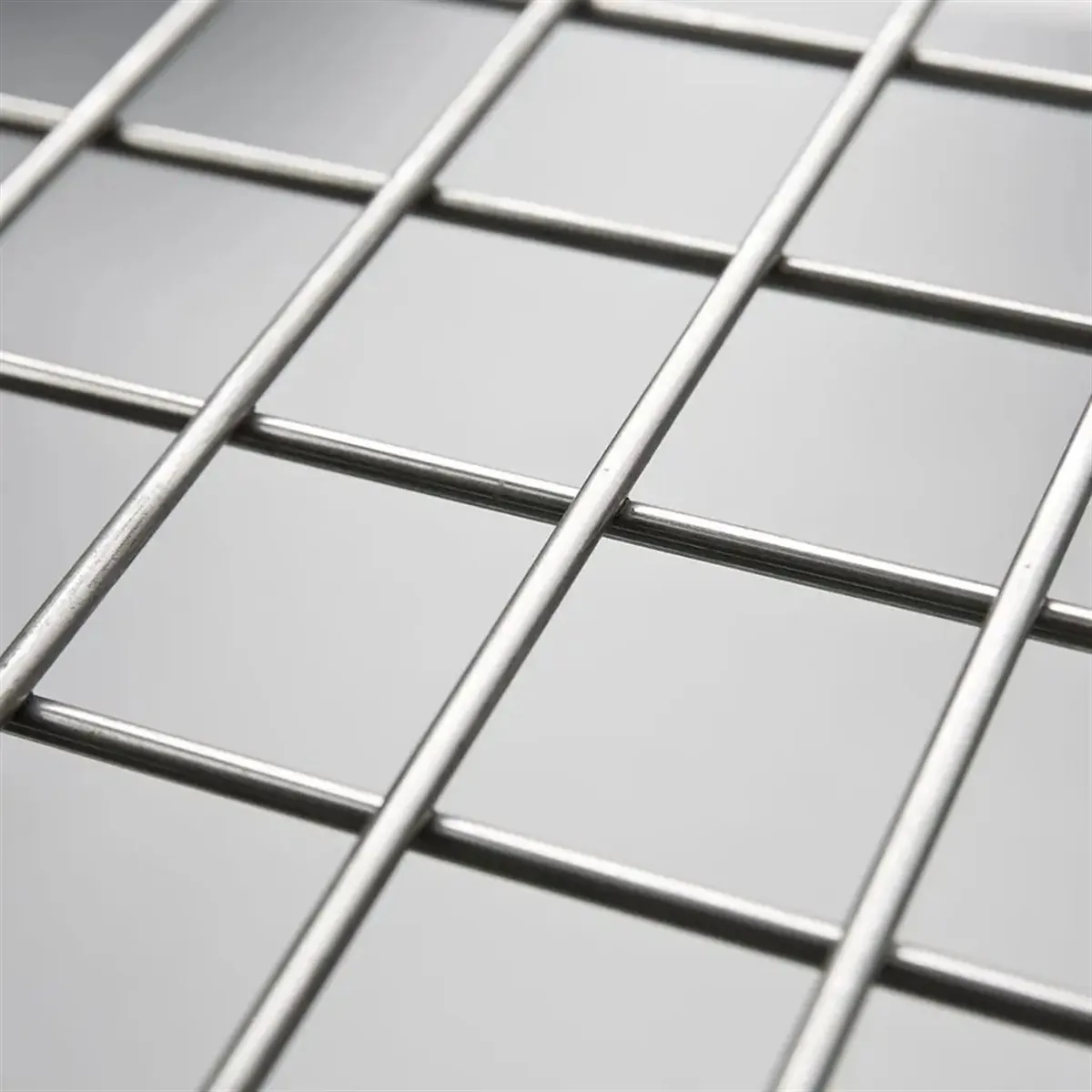 Weld mesh · stainless wire, welded nodes
Weld mesh aperture and wire range
Standard square and rectangular openings below; other apertures, wire diameters and panel sizes are made to drawing. Open area and weight are confirmed on the quotation for the selected grade.
| Aperture inch | Aperture mm | Wire dia mm | Open area | Typical use |
|---|---|---|---|---|
| 1/4" × 1/4" | 6.4 × 6.4 | 0.30 – 0.70 | 78 – 88% | Fine guards, small cages, filtration support, decorative infill |
| 3/8" × 3/8" | 9.5 × 9.5 | 0.35 – 1.00 | 80 – 89% | Guards, partitions, small animal enclosures, mesh trays |
| 1/2" × 1/2" | 12.7 × 12.7 | 0.50 – 1.60 | 83 – 90% | Guards, small cages, filtration support, food-plant racks |
| 5/8" × 5/8" | 15.9 × 15.9 | 0.60 – 1.20 | 84 – 91% | Partitions, poultry runs, rack infill |
| 3/4" × 3/4" | 19.1 × 19.1 | 0.70 – 2.00 | 86 – 92% | Partitions, poultry runs, shelf infill, machine guards |
| 1" × 1" | 25.4 × 25.4 | 0.90 – 2.50 | 85 – 93% | Architectural infill, shelving, machine guards, security screens |
| 1" × 2" | 25.4 × 50.8 | 1.50 – 2.50 | 87 – 92% | Security screens, site barriers, coastal fencing |
| 2" × 2" | 50.8 × 50.8 | 1.70 – 3.00 | 89 – 94% | Heavy guards, food-plant barriers, gabion, rack decking |
| 2" × 4" | 50.8 × 101.6 | 2.00 – 3.40 | 91 – 94% | Livestock panels, structural infill, heavy enclosures |
| 3" × 3" | 76.2 × 76.2 | 2.60 – 4.50 | 89 – 94% | Machine guards, heavy enclosures, walkway panels |
| 4" × 4" | 101.6 × 101.6 | 3.00 – 5.00 | 91 – 94% | Rack decking, coarse guards, structural barriers |
Aperture (clear opening)
The gap between wires, in mm or inch. This decides whether a particle passes — not the mesh count. State it first.
Wire diameter
Sets strength and wear life. A heavier wire for the same aperture reduces open area — the trade-off to settle before the order.
Panel size & edge
Roll or flat sheet, cut-to-size panel, flush edge, framed, folded or mounting tabs. The edge detail makes a panel fit the deck or post.
Open area for square aperture calculated as (a / (a + d))² × 100, and for rectangular a × b as (a / (a + d)) × (b / (b + d)) × 100, where d = wire diameter. Weights assume flat mesh at 8.0 g/cm³ (stainless); alloy grades differ in density. Exact figures are confirmed on the quotation. Tolerances: ±2 mm on overall dimensions of cut-to-size panels; wire diameter to ISO 781 / ASTM A580 tolerances. Finish: mill as standard; electropolished or pickled on request. Grade certificates (EN 10204 3.1, heat number traceable) per batch; third-party inspection (SGS, BV, PSI) on request.
Grade for the weld mesh duty
304
EN 1.4301Indoor guarding, food-area racks, general industrial infill and dry atmospheric duty.
316
EN 1.4401Wash-down plants, coastal and chloride exposure; better pitting resistance than 304.
ASTM A580 / GB/T 4240
Stainless steel wire — diameter, tensile and chemistry, the base spec behind every weld mesh order.
EN 10088-2
Grades 1.4301 (304), 1.4401 (316) — composition and corrosion class for the two weld mesh grades.
ASTM E8 / ISO 6892-1
Tensile testing of the wire; the strength figure quoted for the mesh comes from this test, per heat.
EN 10204 3.1
Mill test certificates with heat-number traceability — chemistry and mechanicals for every batch.
| Industry | Application | Main challenge | Recommended weld mesh |
|---|---|---|---|
| Architectural & façade | Balustrade infill, screens, cladding support | Long spans, finish on show | 25.4 mm, 1.5–2.0 mm wire, 316 for exterior |
| Food & beverage plant | Racks, guards, trays | Hygiene, wash-down | 12.7–25.4 mm, 2.0 mm wire, 304 or 316, electropolished |
| Machine guarding | Perimeter guards, enclosures | Impact, visibility | 25.4–50.8 mm, 2.5–3.0 mm wire, 304 |
| Filtration support | Backing for filter media, strainers | Fine aperture, cleanability | 6.4–12.7 mm, 0.35–1.5 mm wire, 316 |
| Racking & shelving | Deck infill, shelf panels | Load and deflection | 50.8–101.6 mm, 3.0–5.0 mm wire, 304 |
| Marine & coastal | Barriers, cages, walkways | Chloride pitting | 25.4–50.8 mm, 2.5 mm wire, 316 |
| Agriculture & livestock | Cages, pens, fencing panels | Impact, corrosion, easy cleaning | 50.8–101.6 mm, 2.0–3.4 mm wire, 304 or 316 |
Send us an inquiry.
Quote within one working day. Samples available for approval before production.